
The Structured IT Service Maturity Model™
Most IT organizations attempt transformation by introducing new tools or launching large initiatives before operational foundations are stable. True service maturity does not start with technology. It begins with clarity in how services operate. The Structured IT Service Maturity Model is a phased approach that helps IT organizations move from reactive service delivery to structured, measurable, and strategically aligned operations. This model focuses on clarifying ownership, stabilizing workflows, strengthening governance, and enabling sustainable service improvement.
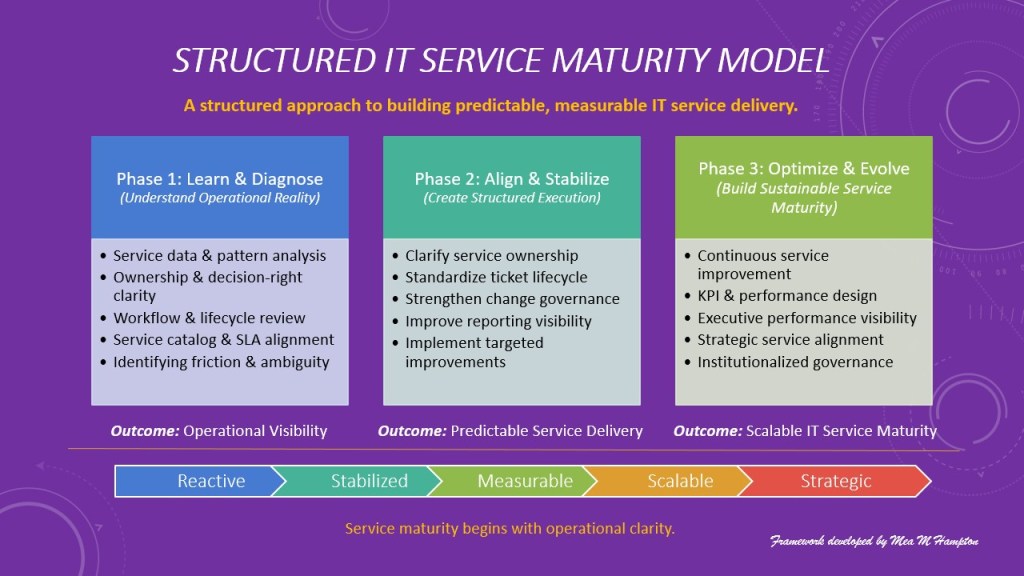
Phase 1: Learn & Diagnose
Understand the Operational Reality
Before improving service delivery, IT leaders must understand how services are actually functioning across teams and systems. This phase focuses on identifying patterns, uncovering hidden friction, and clarifying where operational ambiguity exists.
Key focus areas include:
- Service data and pattern analysis.
- Ownership and decision-right clarity.
- Workflow and lifecycle review.
- Service catalog and SLA alignment.
- Identifying gaps between documented processes and actual behavior.
Outcome: Clear visibility into how IT services currently operate.
Phase 2: Align & Stabilize
Create Structured Service Delivery
Once operational patterns are understood, the next step is to reduce ambiguity and introduce consistent ways of working. This phase focuses on clarifying ownership, strengthening service governance, and aligning ITSM platforms with operational practices.
Key focus areas include:
- Clarifying service ownership and accountability.
- Standardizing ticket lifecycle and workflow practices.
- Strengthening change, incident, and request governance.
- Improving reporting consistency and service visibility.
- Implementing targeted operational improvements with minimal disruption.
Outcome: Predictable service delivery and stronger operational consistency.
Phase 3: Optimize & Scale
Build Sustainable Service Maturity
With stable service operations in place, organizations can begin to optimize performance and scale their service capabilities. This phase focuses on continuous improvement, measurable performance management, and enabling leaders to make informed strategic decisions.
Key focus areas include:
- Establishing a continuous service improvement cadence.
- Designing meaningful KPIs and performance dashboards.
- Aligning service delivery with strategic objectives.
- Strengthening executive visibility into IT performance.
- Institutionalizing governance and decision frameworks.
Outcome: A mature, scalable IT service environment capable of supporting long-term organizational growth.
The Maturity Shift
Organizations that apply this framework typically move through the following progression:
Reactive → Stabilized → Measurable → Scalable → Strategic
The goal is not simply better processes, but a more intentional and resilient IT service organization.
Why This Model Works
Many IT transformations fail because organizations attempt to scale before operational clarity exists.
This framework ensures that service maturity evolves intentionally, allowing teams to reduce friction, strengthen accountability, and build sustainable service performance. The result is an IT organization that is not only operationally effective but also strategically aligned with the enterprise’s goals.
If your IT organization is struggling with inconsistent service delivery, unclear ownership, or limited visibility into performance, this model provides a structured path forward.
Let’s Chat!
If you want to get in touch with me to book, inquire, or ask a question, please contact me via email at MeaHampton@gmail.com, the social media links below, or fill out the form on my Contact Page!
I look forward to hearing from you!


